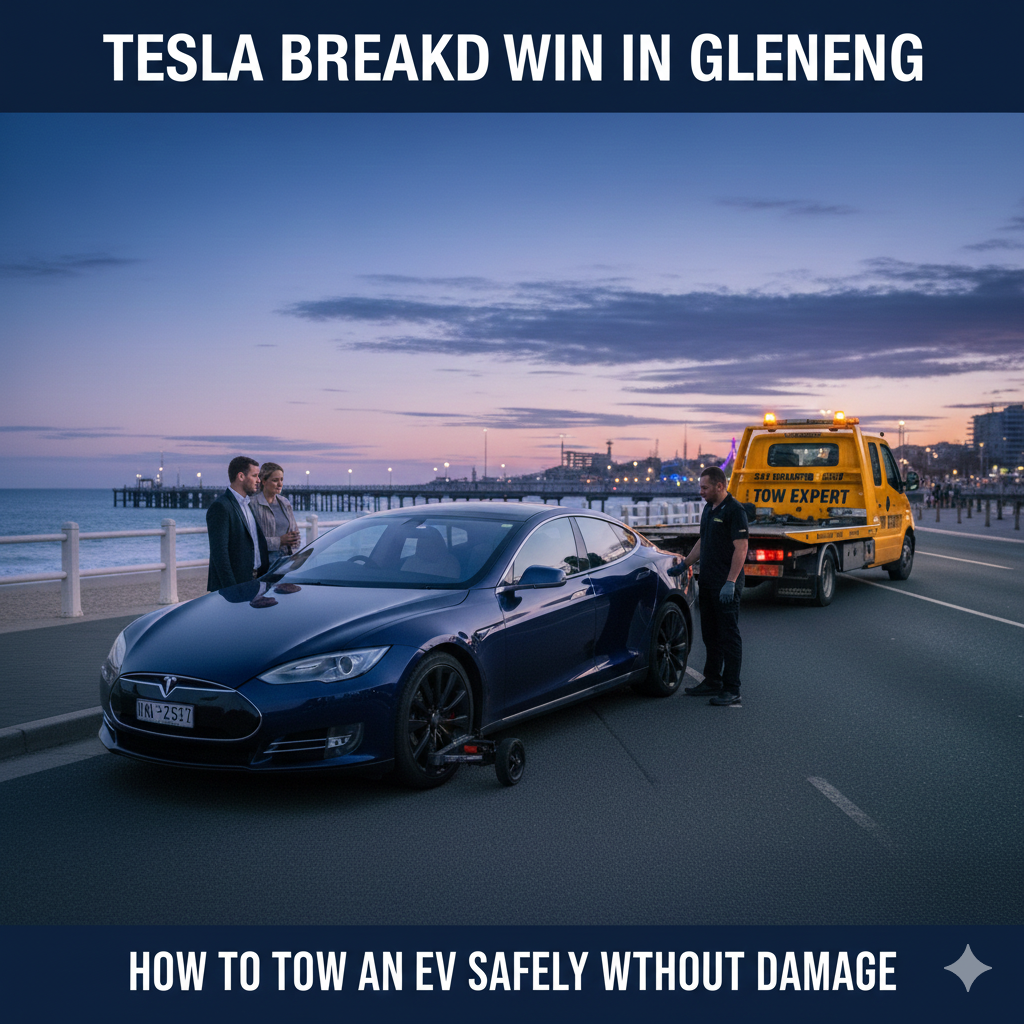
Glenelg’s busy roads see increasing Tesla breakdowns as EV use rises, leading to more callouts for Tow Expert each year.
Towing a Tesla requires specialist handling, strict loading procedures, and certified operators to safely disable the electric drivetrain before transport. Attempting to tow a Tesla on its wheels can result in significant drivetrain damage. This is a different process compared to towing a petrol or diesel vehicle.
This comprehensive article explains the process that Tow Expert follows when recovering Tesla vehicles in Glenelg and surrounding suburbs, including Peterhead, Cleland, Burnside, Christie Downs, and more. Regardless of the issue – whether a flat battery, software lockup, punctured tyre, charging system fault or complete immobilization – understanding what to do next can save time and money.
The EV Boom in Glenelg — and Increasing Breakdown Risk
Tesla ownership has exploded across the city’s coastal strip in recent years. Glenelg, West Richmond, Warradale North, Burnside, and Nailsworth all have high adoption rates, thanks to their close proximity to employment hubs, upmarket residences, and the availability of chargers. Naturally, as more EVs hit the roads, breakdowns are also on the rise.
The most frequent causes for Tesla callouts Tow Expert attends in Glenelg include:
- Low State of Charge (SOC) without nearby charging infrastructure
- Software freezing that locks the car out of Neutral gear
- Tyre punctures (Teslas do not come with a spare tyre)
- Charging port failures
- 12-volt battery failures that render the entire vehicle inoperable
- Accident-related immobilisation
- Overheating or battery alerts resulting from thermal-management system faults
These breakdowns tend to occur along the coastal corridor (Jetty Road, the Marina, the beachfront esplanade) and Glenelg’s congested residential streets around the Glenelg–Morphett Road corridor.
Why You Can’t Tow a Tesla Like a Normal Car
Tesla vehicles have some key differences from combustion-engine vehicles that require a modified approach.
1. Regenerative braking system
Dragging the wheels without engaging the systems can damage them.
- The inverter
- The electric motor
- The battery management system
2. Electronic parking brakes
The parking brake is electronically controlled and cannot be released without properly shutting down.
3. High-voltage system
The high-voltage components must be handled with care as incorrect movement or isolation can trigger errors or cause unsafe conditions.
4. Low-clearance underbody and battery pack
Incorrect lifting points can puncture or stress the battery casing.
For these reasons, a Tesla must never be pulled on its wheels or lifted incorrectly. Towing an EV is a specialist job that should only be handled by qualified EV towing operators.
Step-By-Step Guide to Tow Expert’s Tesla Towing Process
Below are the steps Tow Expert takes to safely and professionally transport Tesla vehicles without causing damage.
Step 1: Assessment and System Shutdown
Upon arrival, Two Expert technicians.
- Confirm the breakdown cause.
- Inspect underbody clearance
- Determine if the software or mechanical lockout is used.
- Ascertain that the vehicle is safe to handle
If frozen/unresponsive, technicians use manual override to:
Open the front trunk.
Release the parking brake.
Activate Tow Mode
Step 2: Initiating Tow Mode
Tow Mode disengages the electric drive motor and allows the wheels to rotate freely.
The process is slightly different for Model 3 vs Model S/X/Y, but usually involves:
- Powering on the car
- Navigating to the service menu
- Selecting the “Tow Mode” option
- Confirming brake release
If 12-volt power is also down, technicians use external jump equipment to energize the low-voltage system and allow Tow Mode to be initiated.
Step 3: Loading Tesla onto Flatbed (Tilt-Tray)
Tesla vehicles require full flatbed transport.
Two Expert uses:
- Soft straps
- Wheel nets
- Adjustable ramps
- Low-angle tilt trays
This prevents:
- Underbody scraping
- Wheel-motor stress
- Battery pack damage
Each strap is connected to designated Tesla tie-down points beneath the chassis.
Step 4: Securing the Vehicle and Transporting
Once loaded, the vehicle is.
- Strapped at four secure points
- Checked for wheel movement
- Positioned to distribute weight correctly
- Lifted safely above the road surface
Transportation routes from Glenelg are planned to minimize sharp turns and rough road conditions to protect the EV.
Step 5: Safe Delivery to a Tesla Service Area or Preferred Mechanic
Depending on the issue, common drop-off points include.
- Tesla Service Centre (Melrose Park)
- EV-certified tyre shops
- Specialist independent EV mechanics
- Home-charging locations for SOC breakdowns
Why Tesla Breakdowns Are Common in Glenelg
Compared to other SA suburbs, Glenelg has the following high-risk conditions:
1. High visitor traffic and stop-start driving
Frequent braking increases thermal stress on EV components, particularly around peak holiday periods.
2. Inconsistent charging availability
Glenelg has some chargers, but demand is high and waiting times are not uncommon.
3. Exposure to salt from the coast
Sea air may increase the risk of corrosion on electronic components.
4. Long commutes between Glenelg and outer suburbs
Drivers heading to or from Andrews Farm, Inglewood, Cleland or Mawson Lakes may miscalculate range.
Also Read:- Do Tow Trucks Give You a Ride
Nearby Suburbs Where Towing a Tesla Is Frequent
Two experts also often assist EV recovery in these suburbs.
- Peterhead – SOC-related callouts near the marina are common
- West Richmond – Located near the airport, it has heavy traffic.
- Warradale North – Frequent commuter breakdowns
- Burnside – Hilly roads add to drivetrain stress
- Nailsworth – Busy arterials can cause tyre failures
- Mawson Lakes – Major EV adoption rate, long-distance commuters
- Andrews Farm – Range miscalculations on long suburban trips
- Inglewood – Uneven terrain impacts battery
- Cleland – Hill climbs can cause overheating alerts.
- Christie Downs – Multi-lane traffic, transport hub
Each suburb represents different risks for Tesla and other EV drivers.
Also Read:- Need a Tow Truck in Melbourne? Call Tow Expert
How to Prevent a Tesla Breakdown in Glenelg
Drivers can take the following precautions.
1. Keep an Eye on SOC Levels
Avoid driving below 10% SOC unless necessary.
2. Only Use Trusted Charging Stations
Third-party chargers often give inconsistent power levels.
3. Schedule Regular Tesla Software Updates
These may be fixed.
- Navigation miscalculations when charging
- Battery-management software bugs
- Regenerative-braking discrepancies
4. Check Tyres Regularly
Glenelg roads by the beach parking areas can have debris.
5. Avoid Deep Sand or Soft Ground near the Beach
Tesla’s traction control is not reliable in sandy environments.
Call Tow Expert If
You should call a Tow Expert immediately if you’re a Tesla.
- Won’t engage Drive or Neutral
- Displays HV battery system warnings
- Has onboard charging unit faults
- Has a punctured tyre
- Has a 12-volt battery failure
- Is the software locked out
- Stops due to low battery
- Shows drivetrain/cooling system warnings
Getting fast professional assistance helps prevent secondary damage and speed up repairs.
FAQs
1. Can a Tesla be towed with its wheels on the ground?
Ans:-No. Never tow or wheel-lift a Tesla vehicle. These should always be transported flatbed with approved procedures.
2. What do I do if my Tesla battery is completely flat in Glenelg?
Ans:-A tow technician will power the 12-volt system, initiate Tow Mode, and safely load the vehicle onto the flatbed for transport.
3. Do you tow Teslas stuck in parking garages?
Ans:-Yes. Two Expert uses low-clearance recovery trucks that are designed for underground and restricted access locations.
4. Can salt from Glenelg Beach cause Tesla problems?
Ans:-Salt can accumulate over time on connectors and electrical components. If you notice your Tesla is stuck near the coast, call a professional.
5. How long will a tow truck take to get to Glenelg?
Ans:-Response time is usually between 20 and 35 minutes, depending on the time of day and location of the vehicle.