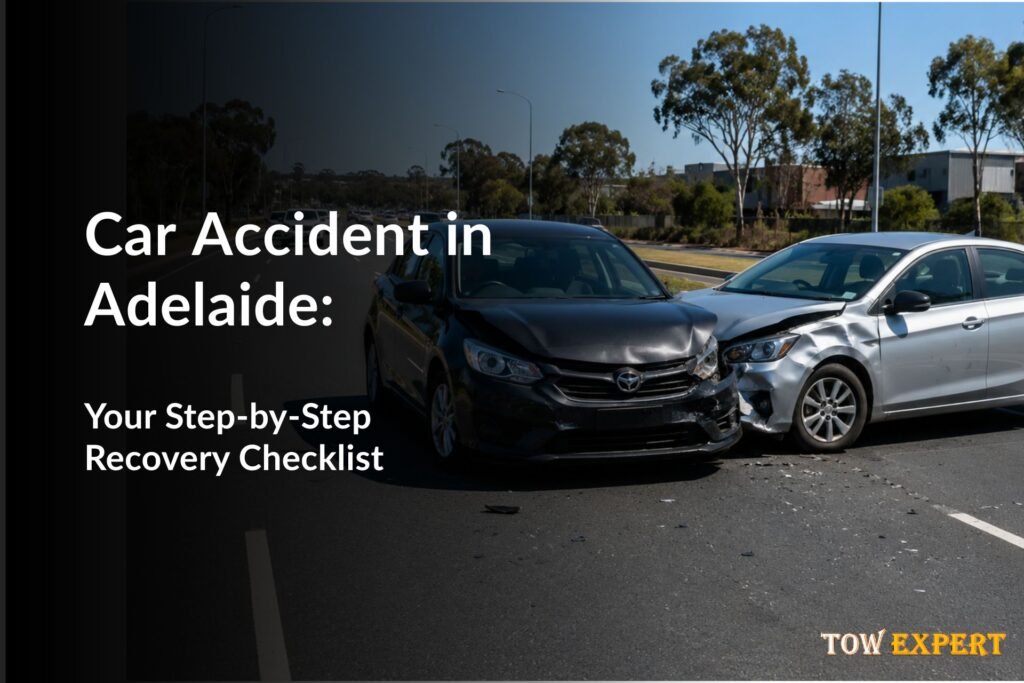
A car accident can leave you feeling shaken, confused, and unsure about what to do next. Even a relatively minor collision can become stressful when you’re dealing with traffic, vehicle damage, insurance questions, and other drivers at the same time.
If you’re involved in a crash in Adelaide, your first priority should always be safety. Once everyone is safe, there are a few practical steps that can make the situation easier to manage.
South Australian road authorities recommend stopping at the scene, assisting anyone who is injured, moving vehicles away from traffic where it is safe to do so, and exchanging relevant information with the people involved.
This guide walks you through what to do after a car accident in Adelaide, including when you may need emergency assistance, how to document the crash, and what to do if your vehicle cannot be driven.
What Should You Do Immediately After a Car Accident in Adelaide?
The first few minutes after a collision can be overwhelming. Try not to rush into decisions. Take a moment to assess what has happened and focus on getting yourself and everyone else to a safe position.
There are a few basic steps to follow:
- Stop at the scene.
- Turn on your hazard lights.
- Check whether anyone is injured.
- Move the vehicle away from traffic if it is safe and possible.
- Contact emergency services if there is an urgent danger or serious injury.
- Exchange the required information with the other people involved.
South Australian guidance specifically requires drivers involved in a crash to stop at the scene. Hazard lights can also be used to warn approaching traffic about the danger.
Check for Injuries
Before worrying about the condition of your car, check yourself and your passengers. If another driver, passenger, cyclist, pedestrian, or anyone else has been injured, their safety takes priority.
Some injuries may not be immediately obvious after a collision, particularly when adrenaline is high. If someone appears seriously injured or needs urgent medical attention, call Triple Zero (000).
If you’re unsure about an injury, getting appropriate medical advice is better than simply assuming everything is fine.
Move Your Vehicle to Safety
If the vehicles are still driveable and moving them won’t put anyone at risk, move them away from moving traffic where possible.
This can be particularly important on busy Adelaide roads, major arterial routes, and during peak traffic when another collision could occur.
However, don’t try to move a badly damaged vehicle if doing so could make the situation worse. If the car cannot be safely driven, keep yourself away from traffic and arrange appropriate assistance.
When Should You Call Emergency Services?
Not every minor collision requires an emergency response, but some situations clearly do.
Call Triple Zero (000) when someone is seriously injured, there is an immediate threat to life, or there is another urgent danger such as a fire. South Australia’s emergency guidance also identifies serious road accidents as situations where 000 should be used.
You may also need police assistance when a crash creates a traffic hazard or blocks the road. For non-emergency police assistance in South Australia, the Police Assistance Line is 131 444.
Situations that may require urgent attention include:
- Serious or potentially serious injuries
- Fire or smoke
- Fuel or other fluid spills creating a hazard
- A vehicle in a dangerous position
- A blocked or hazardous road
- Major collision damage
- Situations requiring police attendance
Don’t put yourself in danger trying to manage a hazardous accident scene alone.
What Information Should You Exchange After an Accident?
Once everyone is safe, exchange relevant information with the other people involved.
South Australian guidance says drivers should exchange information including the driver’s name and address, the vehicle owner’s name and address where applicable, registration numbers, and other information needed to identify the vehicles or assist police.
It’s useful to record:
- Driver’s name and contact details
- Vehicle registration number
- Vehicle owner’s details if different from the driver
- Other relevant vehicle information
- Insurance details, where available
- Witness names and contact details
Try to keep the information accurate. Taking a quick photo of registration plates and relevant documents can also help you avoid mistakes later, provided you can do so safely.
How Should You Document the Accident?
Once you’re in a safe position, document as much of the situation as reasonably possible.
Photos can help show what the vehicles looked like immediately after the collision and may be useful when dealing with your insurer or other parties.
Consider photographing:
- Damage to your vehicle
- Damage to other vehicles
- Vehicle positions
- Number plates
- Road conditions
- Traffic signs or signals
- Relevant debris or hazards
- Visible damage to surrounding property
You can also make a few notes about:
- The time of the accident
- The exact location
- Weather conditions
- Road conditions
- What you remember happening immediately before the collision
If you have dashcam footage, preserve it rather than allowing it to be overwritten.
Most importantly, don’t walk into moving traffic or put yourself in an unsafe position just to get a photograph.
What Should You Do If Your Car Can’t Be Driven?
A vehicle can look relatively normal after an accident and still have problems that make it unsafe to drive.
Pay attention to obvious signs of damage such as:
- Steering problems
- Brake issues
- Damaged wheels or tyres
- Suspension damage
- Fluid leaking from the vehicle
- Warning lights
- Significant body damage
- Deployed airbags
If you’re not confident the vehicle is safe, don’t take the risk of driving it home.
Professional recovery can be the safer option, particularly if the vehicle is sitting in an unsafe position or has suffered significant collision damage.
When Do You Need a Tow Truck?
You may need a tow truck if:
- The vehicle won’t start.
- The collision has caused significant damage.
- A tyre or wheel has been badly damaged.
- The steering or suspension appears affected.
- There is a fluid leak.
- The vehicle cannot be safely driven.
- The vehicle is blocking traffic.
For metropolitan Adelaide crashes, South Australian guidance has specific arrangements for accident towing. The official driver’s handbook states that tow trucks are rostered through the Accident Towing Roster Scheme and that, for crashes within metropolitan Adelaide, the Accident Towing Authority can be contacted on 08 8116 9209.
If you are arranging a tow independently rather than using the accident towing scheme, choose a service with suitable equipment for the condition of your vehicle.
Choosing a Towing Service in Adelaide
When arranging vehicle recovery, don’t focus only on how quickly someone can arrive.
Consider:
- Whether the service is available when you need it
- Whether the truck is suitable for your vehicle
- Whether the operator handles accident recovery
- Whether pricing is explained before the job
- Where the vehicle can be transported
- Whether the operator communicates clearly with you
If you need a tow truck Adelaide drivers can contact for vehicle recovery, explain the condition of the car before the truck is dispatched. A vehicle that cannot roll or steer may require different equipment from an ordinary breakdown.
Where Should Your Damaged Vehicle Be Taken?
Before the vehicle is loaded, decide where you want it to go.
Depending on your circumstances, this could be:
- A repair workshop
- A dealership
- Your home or another secure location
- An insurer-approved repairer
- Another location agreed with your insurer
If you’re using the metropolitan Adelaide accident towing scheme, the South Australian driver’s handbook says the tow truck driver must provide an Authority to Tow form. It also states that you have the right to decide where your vehicle is taken and should write the destination on the form before signing it.
That makes it especially important not to sign something you haven’t read or understood.
For ordinary car towing Adelaide services, confirm the destination and expected cost before the vehicle is transported.
What Should You Tell the Towing Company?
The more accurately you describe the situation, the easier it is for the towing operator to understand what equipment may be needed.
When calling, provide:
- Your exact location
- Nearby street names or landmarks
- Vehicle make and model
- Type of damage
- Whether the vehicle can start
- Whether the vehicle can roll
- Whether it can steer
- Whether airbags have deployed
- Whether there are fluid leaks
- Your preferred destination
- Any immediate safety hazards
For example, saying that the car has a damaged front wheel and cannot steer is much more useful than simply saying, “My car was in an accident.”
If you’re on a busy road, also tell the operator which side of the road you’re on and whether the vehicle is blocking traffic.
What Happens After the Vehicle Is Recovered?
Once your vehicle is somewhere safe, the situation doesn’t necessarily end there.
You may need to:
- Contact your insurer.
- Provide photographs and accident details.
- Provide any police or crash report information required.
- Arrange a vehicle inspection or assessment.
- Follow your insurer’s instructions regarding repairs.
- Keep towing, repair, and other relevant receipts.
South Australia’s CTP Insurance Regulator advises drivers involved in accidents involving injury or death to report the accident to South Australia Police. It also provides guidance for drivers who caused an accident about completing an Accident Report Form for their CTP insurer.
There can also be specific reporting requirements depending on what happened. For example, SA.GOV.AU states that a crash may need to be reported to police within 24 hours when circumstances include a vehicle being towed, injuries, failure to exchange particulars, or damage estimated above $3,000.
Because accident and insurance circumstances can vary, check the current South Australian requirements and your insurer’s instructions rather than assuming every crash follows the same process.
How Much Does Accident Towing Cost in Adelaide?
There isn’t one standard price for every accident recovery.
The cost can depend on factors such as:
- Distance travelled
- Vehicle size
- Extent of damage
- Whether the vehicle can roll
- Whether specialist recovery equipment is required
- Time of day
- Final destination
A straightforward tow from an accessible roadside location can be very different from recovering a badly damaged vehicle after a collision.
If you’re looking into accident towing cost in Adelaide, ask what the expected charges are before authorising the job. The final cost can vary depending on the distance, vehicle condition, recovery requirements, and destination. If your insurer is arranging the recovery, check what is covered under your policy and whether you need approval before choosing a towing provider.
Avoid choosing a service based solely on the lowest advertised price. The right equipment and safe handling matter when a vehicle has been damaged.
Common Mistakes to Avoid After a Car Accident
It’s easy to make poor decisions when you’re stressed. A few common mistakes are worth avoiding.
Driving a Seriously Damaged Vehicle
If the steering, brakes, wheels, suspension, or other important components may be damaged, don’t assume the vehicle is safe simply because it still starts.
Forgetting to Document the Scene
Once vehicles are moved or the area is cleared, important details can be harder to establish. Take photographs when it is safe.
Failing to Collect Relevant Details
Make sure you record the information you need from the other driver and any relevant witnesses.
Arguing About Fault at the Roadside
An accident scene is not the place for a heated argument. Focus on safety, exchanging information, and following the appropriate reporting process.
Agreeing to Repairs Without Understanding the Process
If insurance is involved, understand what your insurer requires before authorising repairs or moving the vehicle somewhere that could complicate the claim.
Delaying Important Communication
Keep your insurer informed and retain documents, photographs, receipts, and other relevant information.
Car Accident Recovery Checklist
Save this checklist so you have a simple reference if you ever need it:
- Stop at the accident scene
- Turn on your hazard lights
- Check for injuries
- Call 000 if there is a serious injury or immediate danger
- Move the vehicle away from traffic if it is safe to do so
- Exchange relevant driver and vehicle information
- Record witness details
- Photograph the accident scene when safe
- Note the time, location, and road conditions
- Contact your insurer when appropriate
- Don’t drive a vehicle that may be unsafe
- Arrange appropriate vehicle recovery if necessary
- Confirm where the vehicle should be taken
- Keep towing and repair receipts
- Keep your accident documentation together
Frequently Asked Questions
What should I do after a car accident in Adelaide?
Stop at the scene, turn on your hazard lights, check for injuries, and move vehicles away from traffic if it is safe to do so. Call 000 for serious injuries or immediate danger. You should also exchange the required information with other parties and follow South Australian crash-reporting requirements.
Do I need a tow truck after a minor accident?
Not necessarily. If the vehicle is undamaged and safe to drive, towing may not be needed. However, even a seemingly minor collision can affect steering, brakes, wheels, or suspension. If you’re unsure whether the car is roadworthy or safe to drive, professional assessment and recovery may be the safer choice.
Can I drive my car after an accident?
Only if you are confident the vehicle is safe and legally able to be driven. Damage to the steering, brakes, tyres, wheels, suspension, lights, or other critical components can make driving dangerous. When in doubt, don’t take the risk. Arrange appropriate recovery and have the vehicle assessed.
What information should I collect from the other driver?
You should exchange relevant information including the driver’s name and address, the vehicle owner’s details where applicable, the vehicle registration number, and other information needed to identify the vehicle or assist police. Witness details can also be useful.
How much does accident towing cost in Adelaide?
The cost varies depending on the distance, vehicle size, damage, recovery difficulty, equipment required, time of day, and destination. There is no single price that applies to every accident recovery. Ask the towing provider or your insurer about expected costs before authorising the service.
Can a tow truck take my damaged car to my preferred mechanic?
In many circumstances, a vehicle can be transported to a workshop or other location you choose, but your insurance arrangements may affect where the vehicle should go. Confirm the destination before the tow begins. For metropolitan Adelaide accident towing under the official scheme, the driver’s handbook states that the vehicle owner has the right to decide where the vehicle is taken.
What should I do if my car is blocking the road?
First, prioritise your own safety and the safety of other road users. If the vehicle can be moved safely, South Australian guidance recommends moving it away from traffic. If it cannot be moved or the situation creates a traffic hazard, seek appropriate police or towing assistance rather than attempting a risky recovery yourself.
Can I arrange accident recovery at night?
Yes, recovery may be available outside normal business hours, but availability depends on the towing provider and the circumstances of the accident. If you’re dealing with an immediate danger or serious injury, contact emergency services first. If the vehicle simply needs recovery, explain the situation and location clearly when arranging the tow.
Conclusion
A car accident can turn an ordinary drive through Adelaide into a stressful situation within seconds. The best thing you can do is slow down, focus on safety, and work through the necessary steps one at a time.
Check for injuries, move away from traffic when it is safe, exchange the required information, document the accident, and contact your insurer when appropriate. If your vehicle has suffered damage that makes it unsafe to drive, don’t take the risk of getting back on the road.
When you need vehicle Towing, Tow Expert can assist with towing in Adelaide. Explain your vehicle’s condition and location clearly so the right assistance can be arranged for your situation.
A few minutes spent following the right steps can make the recovery process much easier and help you get yourself and your vehicle safely to the next stage.